
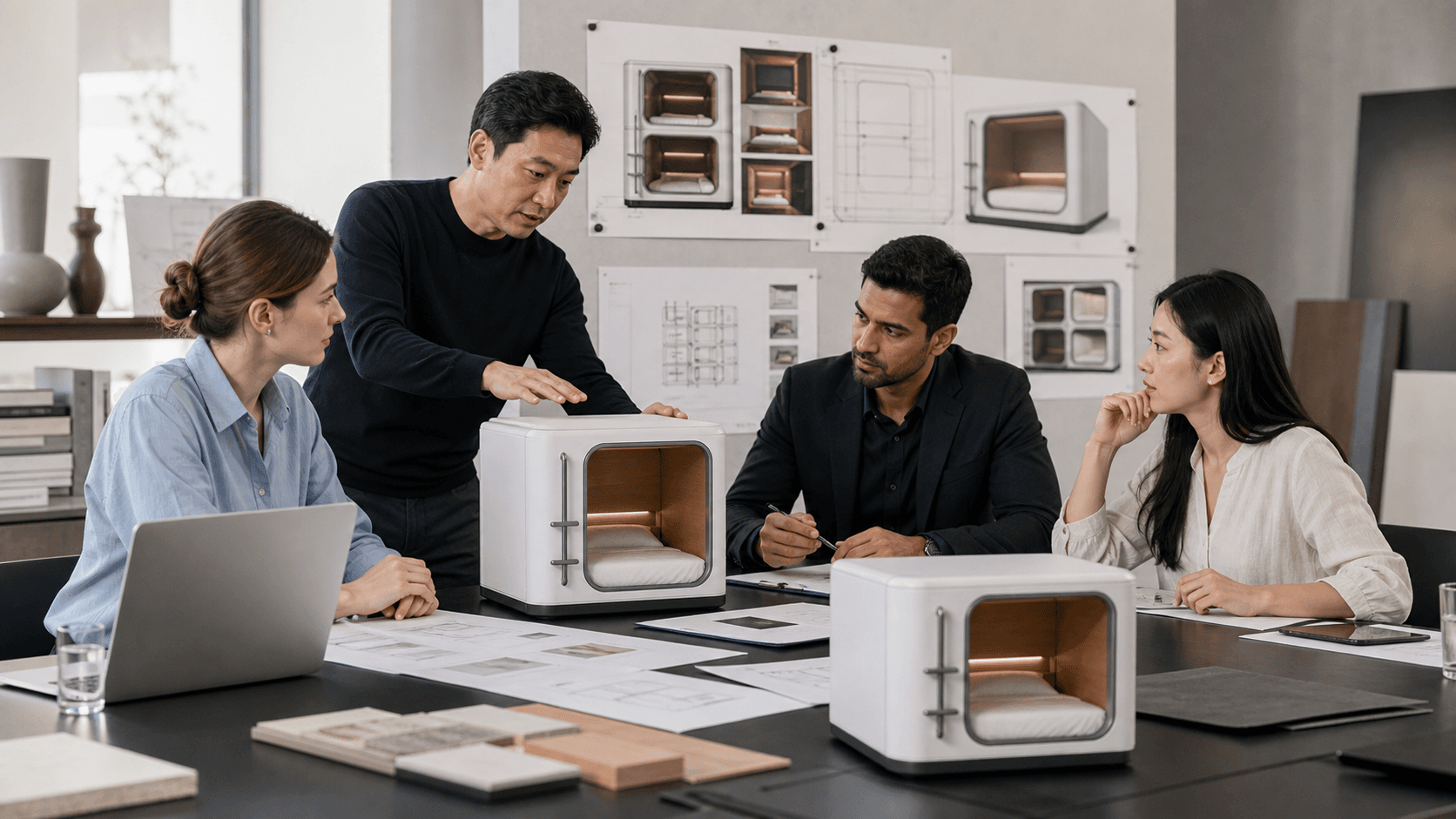
Choosing a Capsule Sleep Pod is not the same as choosing a piece of bedroom furniture. In a commercial project, the pod becomes part of a larger operating environment: a capsule hotel, youth hostel, airport rest zone, corporate facility, hospital support area, student residence or another managed space. The product must fit the room, the guest journey, cleaning routines, electrical infrastructure, local approvals, shipment plan and maintenance capability. A low unit price cannot compensate for a model that conflicts with the site or arrives without the documents the project team needs.
The most reliable buying process therefore begins with a project brief, not a catalogue comparison. Buyers should define the intended use, occupancy, available dimensions, destination and operational priorities before asking suppliers to recommend a model. This guide explains the questions that help turn an attractive product image into a procurement decision that designers, operators and finance teams can evaluate. It does not replace advice from the local architect, fire consultant, electrical engineer or authority having jurisdiction; it gives those specialists a clearer product package to review.
1. Define the commercial use before comparing models
Start by describing what the guest or employee will do in the pod and how long the typical stay will be. An airport nap facility may prioritize rapid turnover, intuitive access and short-duration comfort. A capsule hotel may need a stronger balance of privacy, luggage management, housekeeping access and overnight ventilation. Student or staff accommodation can place more weight on repeat use, durability and maintenance. A hospital-related rest area may introduce stricter cleaning protocols and facility-specific risk reviews. The phrase “sleep pod” covers several formats, so a supplier cannot make a responsible recommendation from quantity alone.
Create a one-page use statement that records the site type, target user, expected length of stay, operating hours, supervision level and intended guest capacity. Include whether the pods will be stacked, installed against a wall, arranged as free-standing modules or integrated into a wider interior fit-out. Record whether users need a door, curtain or open access, but do not assume that every closure method will be acceptable under local egress or fire requirements. This short document becomes the reference for product selection and protects the project from later decisions based only on appearance.
- Site and room type
- Typical stay duration
- Target users and accessibility needs
- Expected occupancy and turnover
- Supervision, cleaning and maintenance model
2. Check the room and circulation before fixing pod quantity
A theoretical pod count is not a workable layout. The project team must allow for circulation, entrance and exit routes, structural columns, ceiling services, sprinklers, detectors, ventilation, cleaning access, luggage, lockers and accessible routes. Stacked pods may improve density, but they also introduce ladder access, fall protection, upper-level housekeeping and guest suitability questions. A model that fits the floor area can still fail because the entrance opening, service panel or installation route is obstructed.
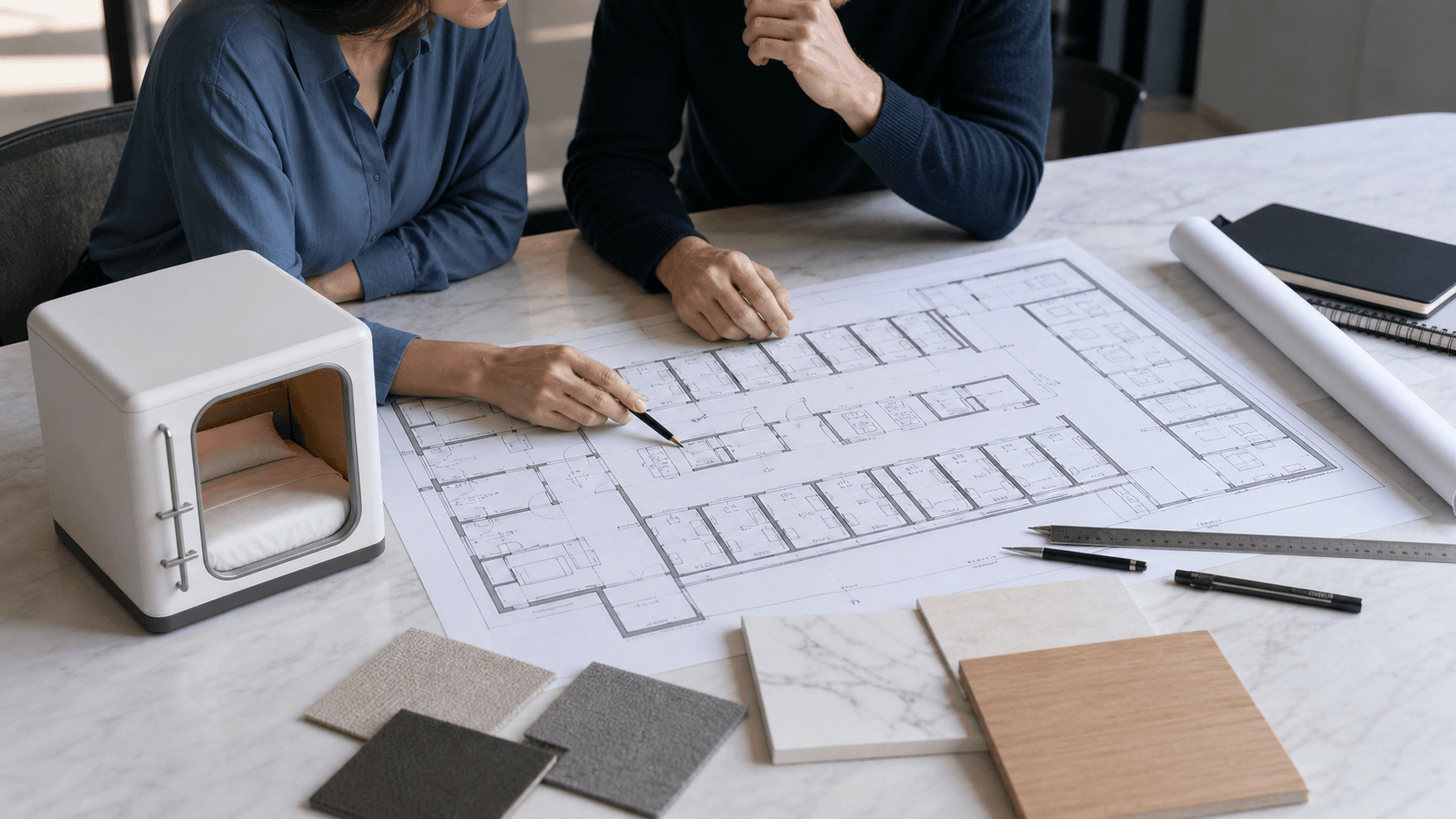
Send the supplier a dimensioned plan rather than a screenshot from a property listing. Mark ceiling height, door widths, lift dimensions, stair turns, loading access and any areas that cannot carry equipment. Ask for the external pod dimensions, required installation clearances and service access zones for the specific model. Then have the local design team overlay the product arrangement with code-required circulation and building services. Do not use a supplier’s concept layout as approval evidence; treat it as coordination input for the licensed local professionals.
3. Compare single, double, premium and customized directions
A Single Capsule Pod generally offers the clearest path to high-density individual accommodation. It can suit capsule hotels, hostels, transit rest and staff facilities where personal privacy matters. A Double Capsule Pod provides a larger sleeping format, but the larger bay affects room mix, access and logistics. A Premium Capsule Pod usually adds a more refined interior direction or additional controls, which should be evaluated against the target rate, guest expectations and maintenance capacity. Customized Sleep Pod work is appropriate when branding, finishes or integration requirements cannot be met by a standard model, but customization also increases the number of decisions that must be frozen before production.
Ask the supplier to identify which elements are standard and which are optional. The answer should distinguish the product family from the ordered configuration. Doors, access systems, reading lights, ventilation components, outlets, control panels, mattresses, interior finishes and exterior colors may vary by model. Product names are not specifications. The quotation, drawings and order confirmation should all point to the same model and version so that the buyer does not approve one image and receive a materially different configuration.
4. Evaluate comfort as a system, not a feature list
Guest comfort is produced by the interaction of space, ventilation, temperature, lighting, mattress, acoustic conditions and perceived privacy. A fan specification on its own does not prove that the occupied pod will feel comfortable. Ask how air enters and leaves the sleeping area, whether airflow can be adjusted, how the pod interacts with the room HVAC system and which components require cleaning. The local mechanical engineer should review total heat and ventilation loads for the whole room, not only a single module.
Acoustic language also needs discipline. Terms such as “soundproof” are often used loosely, although openings, ventilation paths, doors and the surrounding room influence actual performance. Request the test method and configuration behind any stated acoustic result. If no relevant test is available, evaluate the claim as a design intention rather than a guaranteed value. For a pilot room, test typical noises such as doors, ladders, alarms, fans, luggage and late-night conversation. Operational rules and soft finishes outside the pod can matter as much as the shell.
5. Review materials, cleaning and replaceable parts
Commercial operators need surfaces that can be cleaned repeatedly without rapid deterioration. Ask for the material schedule for the ordered model: external panels, internal liners, edge details, mattress cover, hardware and frequently touched controls. Confirm the cleaning agents the supplier recommends and whether strong disinfectants could damage finishes, adhesives or printed controls. A healthcare or high-turnover environment may have cleaning requirements that differ substantially from a boutique hostel.
Maintenance planning should identify the parts most likely to need service: fans, lights, outlets, switches, locks, hinges, control boards and trim. Ask how technicians reach those parts after installation and whether pods must be moved to replace them. Request a recommended spare-parts list for the project quantity and a clear method for identifying component versions. A product that can be repaired from an accessible service panel may reduce downtime more effectively than a model with more features but poor access.
6. Put fire, electrical and egress review before purchase
Sleep capsules are occupiable products used inside a building, so the project must be reviewed as a combined product-and-building condition. UL Solutions notes that UL 962 includes electrical, fire and egress considerations for prefabricated booths and sleep capsules, while also advising installers to contact code authorities about local rules. Singapore’s Fire Code contains specific provisions for capsule hotels, including detection inside capsules and requirements related to access openings. These examples show why a certificate name alone is not a global approval.
Before issuing a purchase order, ask the local authority or appointed consultant how the pods will be classified and which evidence is required. Confirm electrical voltage, frequency, plug or hard-wiring method, circuit protection, cable routing, grounding and labeling for the destination. Review how occupants exit, how staff or first responders gain access, and how the building’s alarm and suppression strategy interacts with the pods. CE, RoHS, ISO or any other name should be shown only where it applies to the relevant model, component, scope and market; request the supporting document rather than accepting a logo strip.
7. Assess the supplier’s project-control capability
A capable supplier should be able to control information across sales, drawings, production, inspection and shipment. Test this during the quotation stage. Provide a clear question list and check whether answers identify the model, option and document revision. Ask who owns technical coordination, how changes are approved and how the final configuration is locked. If different sales messages contradict one another, the risk usually grows after payment rather than disappearing.
Manufacturing strength should be demonstrated with relevant evidence, not broad claims. Depending on the project, useful evidence can include a bill of materials or material schedule, production checkpoints, ordered-model photos, packing method, inspection records and component identification. If a factory visit is possible, focus on process control and traceability. If it is not, request a live review or dated evidence tied to the order. Do not assume that an impressive showroom proves capacity, ownership or consistent quality.
8. Define testing and shipment inspection in the order
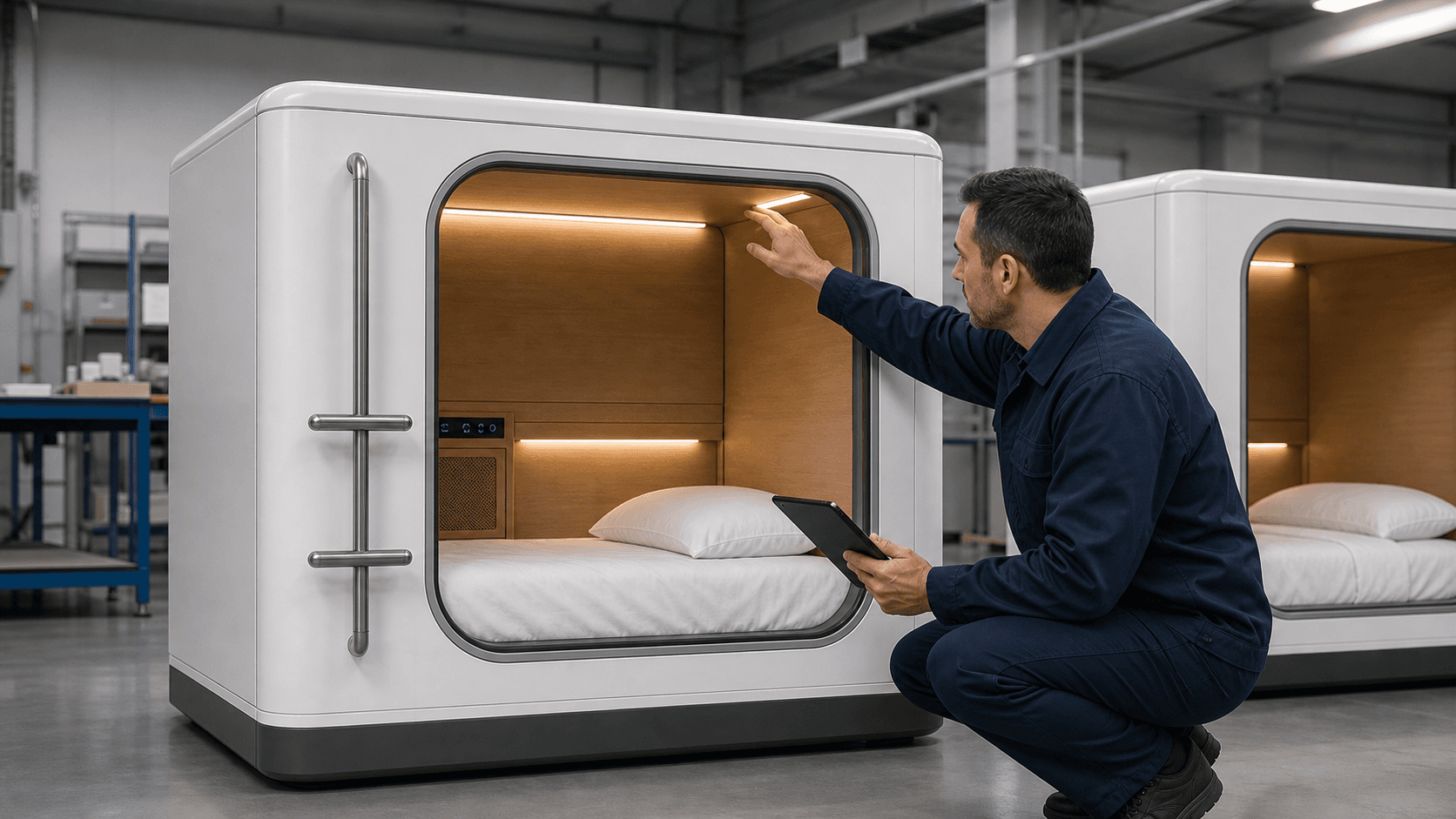
A shipment inspection is most useful when the acceptance criteria are agreed before production. Create a checklist covering quantity, ordered model, finish, visible condition, doors or access components, lights, fans, outlets, control functions, labels, accessories, documentation and packing marks. Decide whether testing will cover every unit or a defined sample, and identify who can approve exceptions. Photos should show the order identity and inspected features, not only generic factory scenes.
Packing must be evaluated against the route and installation sequence. Ask for package dimensions, gross weights, handling points, stacking limits and moisture protection. Confirm whether the site can receive the package and move it through doors, lifts and corridors. A pod that survives factory testing can still be damaged by unsuitable packing or impossible site access. Link the packing list to installation zones or unit numbers when this will reduce sorting time on site.
9. Compare total project value, not only unit price
Normalize quotations before comparing them. One offer may include mattresses, access hardware, spare parts, packing and documentation, while another excludes them. Record the Incoterm, currency, payment milestones, production lead-time basis, warranty scope, spare-parts terms and excluded work. Separate product price from freight, duties, local installation, building services, permits and fit-out. The lowest quoted unit price can become the highest installed cost if essential scope appears later.
Finally, protect schedule assumptions. Lead time normally depends on model, quantity, confirmed configuration and production capacity, and shipping time is separate. Do not plan opening day from an informal estimate. Build time for drawing approval, samples if required, production, shipment inspection, freight, customs, site readiness, installation, testing and local inspection. A responsible quotation should state what must happen before the lead-time clock begins.
Frequently asked questions
What information should I send for a Capsule Sleep Pod quotation?
Send the destination country, application, estimated quantity, room dimensions or plan, preferred pod format, target schedule and any required electrical or access features. This allows the supplier to identify the right model and the questions that still need confirmation.
Should I choose a standard model or a customized sleep pod?
Use a standard model when it meets the operating and design brief because it normally reduces decisions and documentation risk. Consider customization when brand, layout or integration requirements are genuinely project-specific, and allow more time for drawings, samples and approval.
Can one certification package be used in every country?
No assumption should be made. Requirements depend on product classification, components, use, building and destination. Ask local authorities or consultants what applies, then request model-specific evidence from the supplier.
How do I verify ventilation and acoustic claims?
Ask for the stated test method, product configuration and result. Review whole-room ventilation with the local engineer, and use a pilot installation or representative test when comfort or noise is commercially critical.
What should a pre-shipment inspection include?
It should verify order identity, quantity, finish, visible condition, key functions, labels, accessories, documents and packing against agreed acceptance criteria. Define the sample size and evidence format before production.
Conclusion
The best Capsule Sleep Pod is not the model with the longest feature list. It is the model whose use, layout, configuration, compliance path, maintenance plan and commercial scope have been made clear enough for the project team to approve. Buyers can reduce risk by treating product selection as a controlled sequence: define the use, validate the room, compare ordered configurations, review local requirements, agree inspection criteria and normalize the total project cost.
If you are preparing a commercial project, send GEELYE the destination, application, estimated quantity and available room plan. We can help organize the product questions and provide model-specific information for your design and procurement review. Final specifications, documents and compliance suitability remain subject to the selected model and destination requirements.
Authoritative references
Regulations and standards change. Check the current edition and obtain local professional advice for your destination.