
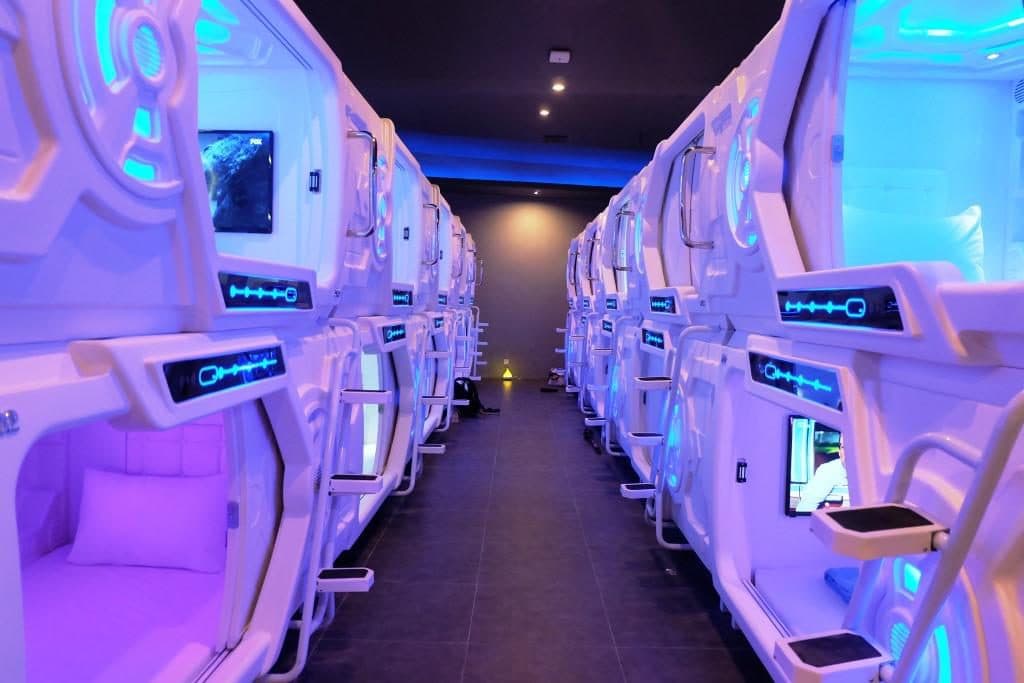
1. Explain the privacy form before guests book
Privacy begins with an accurate description of the room. A curtain, a screen and a closable pod door are different experiences. Each may reduce direct views into the sleeping space, but none turns a bed in a shared room into a private hotel room. The booking page should identify the room type, whether toilets and showers are shared, and what closes around the assigned bed. If bed categories have different entrances, show those differences where the guest chooses a category, not in a general note at the bottom of the site.
Use photographs of the actual room category. Show the closure open and closed and the shared aisle from a guest viewpoint. A cropped pod image cannot show how close the next bed is or where guests change clothes. If a curtain stops short of the floor or a door has gaps, describe visual privacy without promising acoustic isolation. Voices, steps and alarms may still be heard. Quiet-hour rules and a way to ask for help matter too.
Think through a late arrival. A guest enters while others are asleep, finds the right bed, sets down a small bag and closes the entrance. Can that happen without opening the wrong pod or switching on a bright room light? Can the guest read the bed number and find a private changing area? These questions turn an abstract promise of privacy into a sequence the opening team can observe. They also reveal where a sign, room instruction or different allocation rule is needed.
Match the booking description to the installed category. Confirm the closure and help procedure before making a guest promise.
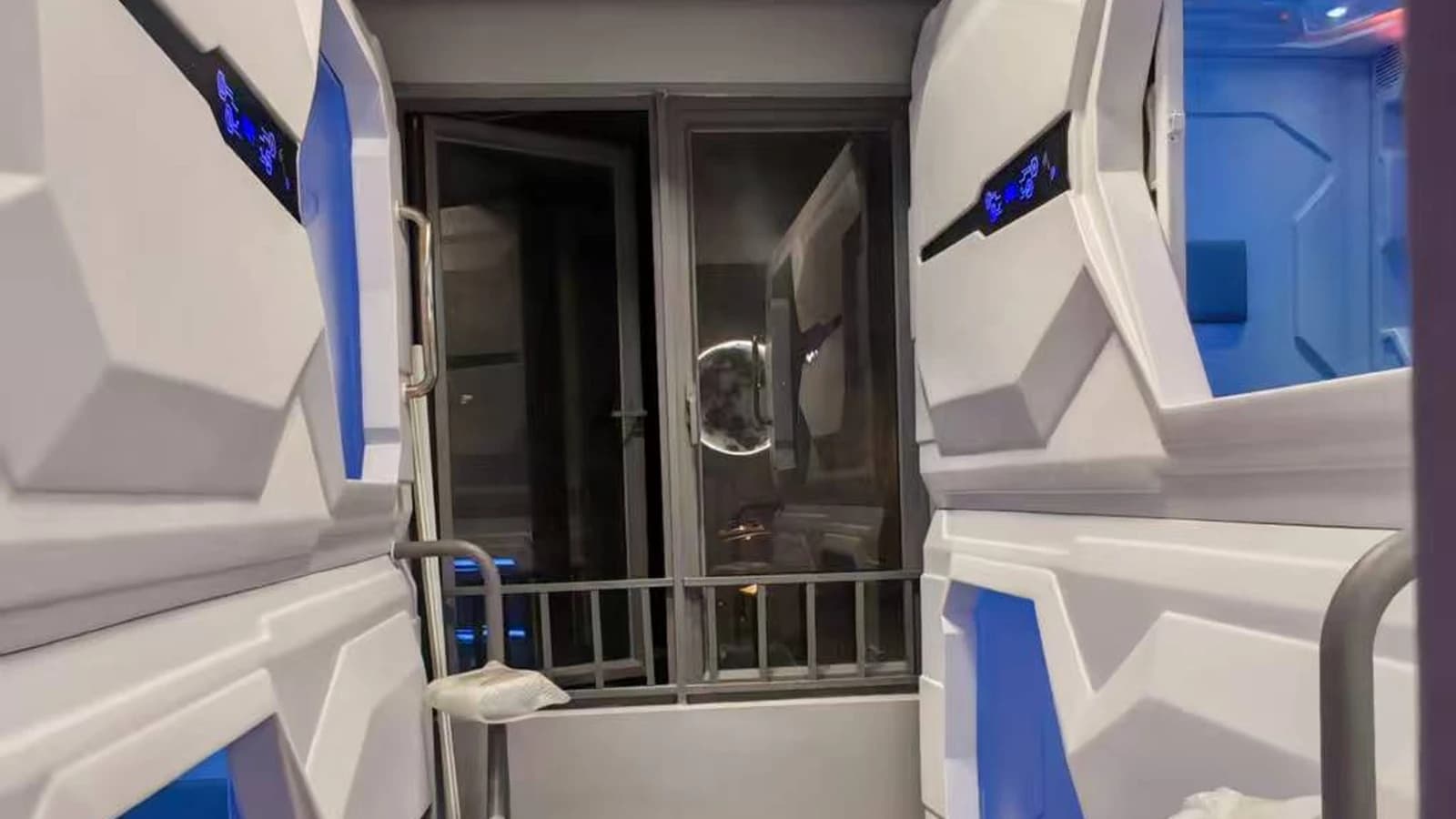
- Name the room and bed category, including upper or lower position when sold separately.
- Show the real curtain, screen or door for that category.
- Explain shared bathrooms, changing space, quiet hours and the night help route.
- Verify any inside-lock statement against the installed unit.
2. Check ventilation and show guests what they can control
The word ventilation often hides two systems. The building or room system manages the occupied space. A fitted pod fan or air opening may move air around the sleeping position. The final guest experience depends on how those systems work together after the pod entrance is closed and the room is occupied. A fan switch that lights up does not prove adequate fresh air, a comfortable temperature or a quiet night. The project mechanical team must confirm the room design and any site performance statement; the operator must learn what the guest can actually adjust.
Start with the exact model and order configuration. Does the assigned bed have a fan control, a vent that must remain clear, or no guest-adjustable air function? Does the room thermostat serve the whole dorm? Are there positions near doors, windows or room supply points that feel different? Put the answer into plain guest instructions: name the control, describe its permitted use, and state who to contact when the space still feels hot, cold or stuffy. Do not describe a pod fan as a private air conditioner unless the installed system really provides that function.
A useful observation happens with the room in its intended night condition, not while construction doors are open. Ask the site team to test representative upper and lower beds with closures in the normal sleeping position. Note drafts, fan noise, odors and blocked openings. Record the bed number, time, room condition and observation rather than guessing the cause. A guest saying 'this feels stale' may be reporting a room-system problem, a blocked local opening, an unfamiliar control or something else. The response should preserve that distinction so the right person can investigate.
Guest instructions should also tell people what not to do. A bag, blanket or improvised covering must not block an opening needed by the approved design. If the guest cannot change the room temperature, say that directly and provide a help path. A short instruction card by the control is more useful at midnight than a technical specification buried on the booking site. GEELYE can provide information about the selected pod's supplied air-movement features; the building services team remains responsible for the complete installed ventilation strategy.
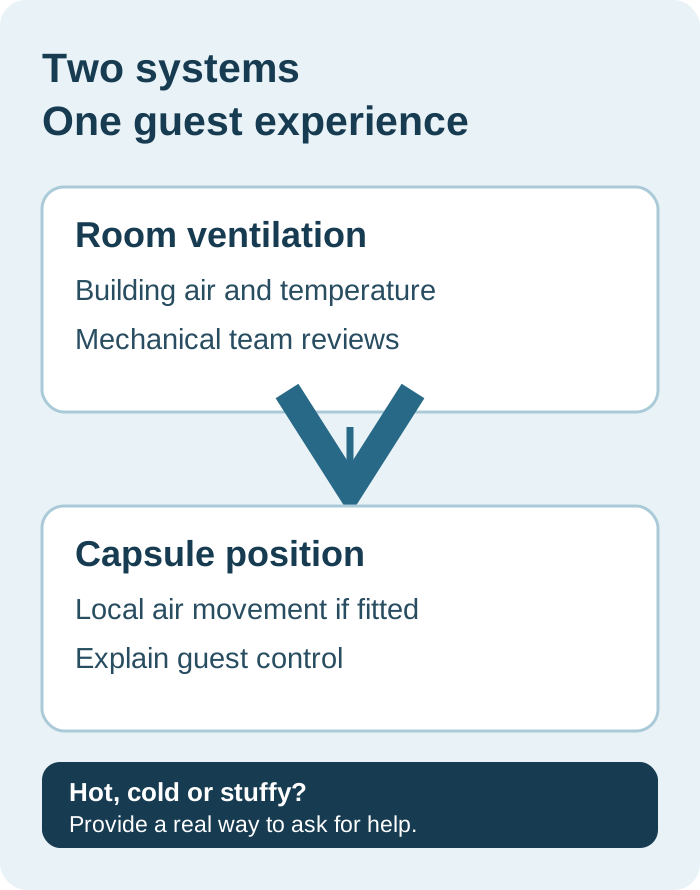
- Confirm the room system and selected pod configuration with the project teams.
- Observe a closed pod in the intended night setting, including upper and lower positions.
- Explain guest-adjustable functions and provide a discomfort contact.
- Record observations without turning them into unverified airflow claims.
Match pod controls to your room plan
Share the selected model, room layout and operating hours. GEELYE can clarify supplied pod functions for your project team to review alongside the building systems.
Discuss the pod configuration3. Walk the bathroom route after dark
A capsule may be comfortable while the journey out of it is not. Guests leave bed to use the toilet, wash their hands, shower at an unusual hour or ask reception for help. Walk those routes with the lighting and door states the property will use at night. Begin at a specific upper and lower bed. Find the ladder or step, the room door, the toilet, the wash area and the way back. A drawing can show distances, but it cannot show a confusing turn, a light that shines into sleeping pods or a door that closes too loudly.
Look at signs from the direction of travel. Can a guest locate a facility without waking someone to ask? Are bed numbers readable under the normal night setting? Does the route pass luggage, a housekeeping cart, a loose mat or a queuing area? A plan that looks clear when empty may feel different after a late check-in. Check the route with the overnight staffing pattern as well: if reception is closed, the instructions must point to a real available help method, not an unstaffed desk.
Convenience is not only about distance. A traveler may need glasses, a walking aid or help with an upper bed. Describe accessible routes and suitable bed categories from the site's assessment; a lower pod alone does not make the stay accessible. Explain how to request an appropriate bed and when it can be confirmed. Local specialists must review regulated accessibility, escape and lighting requirements.
Check the effect on other sleepers. A light may stay on too long, a washroom door may slam, or a returning guest may search for the bed number. Clearer signs and check-in guidance may help; a door fault needs a technician. Record who owns each issue. Keep exits and safety systems as approved.
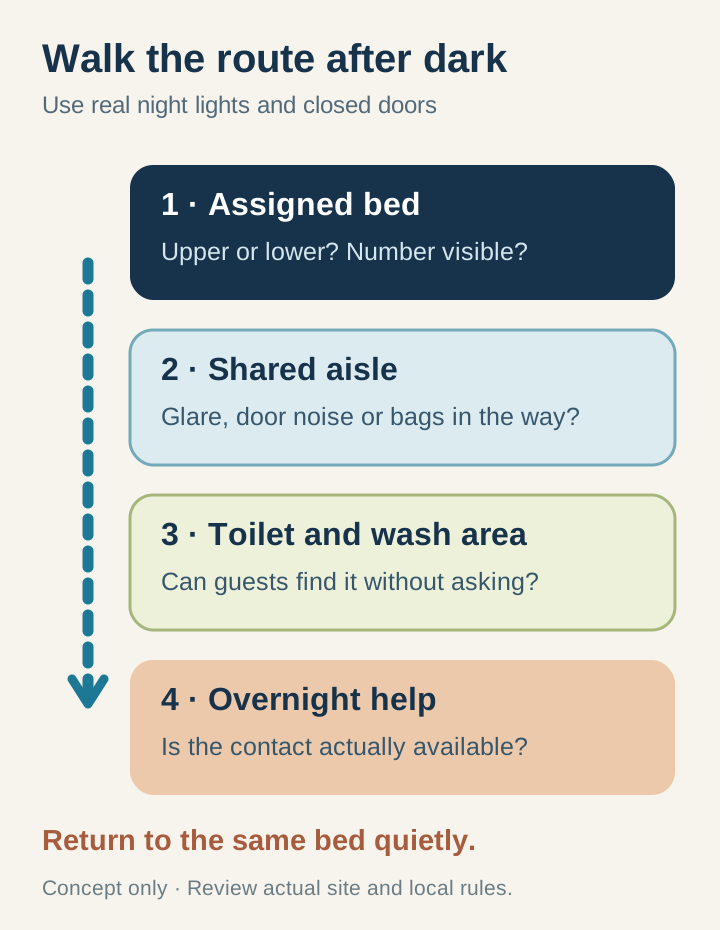
- Walk bed to toilet, wash area and help point, then back to the same bed.
- Repeat under normal night lighting and with expected doors closed.
- Notice glare, noise, bed-number visibility, obstacles and upper-bed access.
- Have qualified local teams review accessibility and emergency routes.
4. Separate pod access from valuables storage
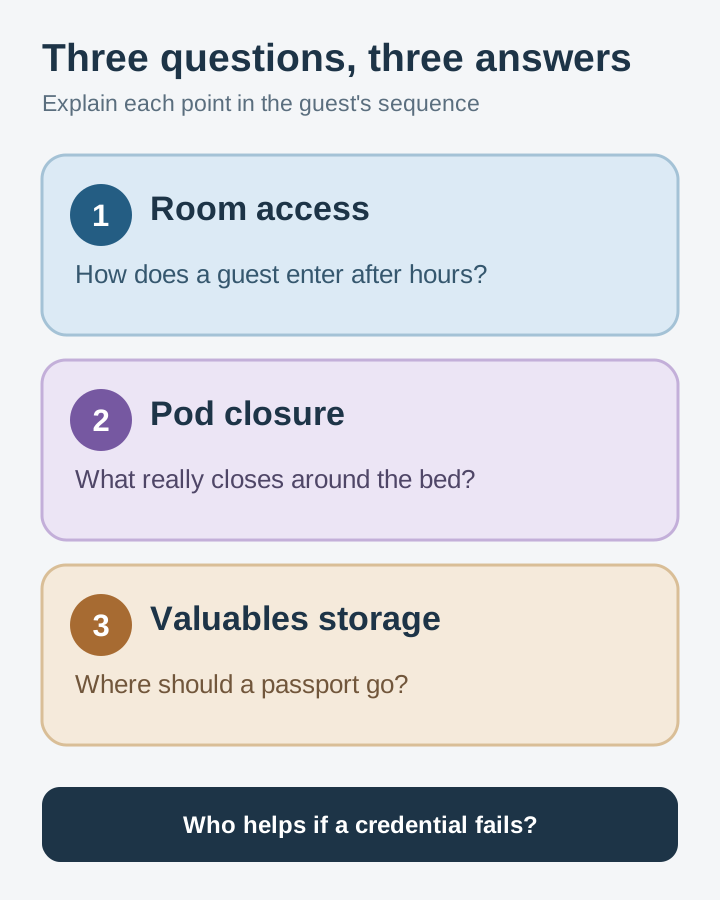
A pod entrance and a valuables locker answer different questions. A curtain or panel may give visual separation. A fitted lock may control one opening, depending on model and local rules. A locker or managed storage service may provide a separate place for a passport, laptop or another valuable item. Do not describe one of these as if it performs all three jobs. Guests need to know which door closes, which compartment locks, what credential they receive and where they should keep items they do not want at the bedside.
Map the normal access journey. What does the guest use at the main entrance, room door, pod entrance and locker? Are these the same key, card, code or separate methods? What happens if a card is lost after reception hours? The operator should document how staff verify the guest and restore access, who can assist, and when a bed or locker must be taken out of service. That process is part of the guest promise. A feature list saying 'electronic lock' is not enough if the staff response is undefined.
The installed closure also needs an agreed assistance and emergency method. Staff should follow the approved instructions for that property rather than adding an improvised latch or promising that a guest can always lock a pod from inside. Local building and fire requirements may shape the arrangement. Ask the relevant local professionals to review the final access and escape design; product information alone cannot approve a building. For guest copy, use exact words such as 'curtain', 'closable door', 'inside latch if fitted' and 'individual locker if provided'.
Show the storage service in use. If there is one locker per bed, confirm that allocation at booking and check-in. For reception storage, describe hours, the handover record and exclusions. If there is no dedicated valuables storage, say so and explain the available alternative without suggesting a closed pod prevents theft. Locker instructions must match the booking page and night staff procedure.
5. Give luggage limits and a useful arrival plan
Travelers do not all arrive with a small backpack. Some carry a wheeled cabin case; others bring a large suitcase, a work bag or equipment. The booking page should say where each broad bag type can go and when the service is available. Do not claim that a 'standard suitcase' fits a locker without measuring the usable internal space and the clear opening of the installed cabinet. Wheels, handles and the direction a case must turn can change the result. If a measurement is not yet available, give a truthful limitation and ask the guest to contact the property before bringing a large item.
Offer an arrival plan rather than a vague warning about limited space. Tell guests whether they should take overnight essentials out of the large case before entering the sleeping room, whether a locker is assigned by bed, and where bags wait before check-in or after checkout. State reception or collection hours, any capacity limit and any extra charge before payment. Where a storage service needs staff, explain what happens for a late arrival or early departure. A guest who learns these rules in the corridor may have to unpack beside sleeping neighbors.
Test the bag journey physically before opening. From the entrance, follow the route to allocated storage, then to a bed, bathroom and exit. Observe where a traveler might stop to open a case and whether another guest can still pass. Keep belongings out of aisles and exits. Exact storage capacity, cabinet fit and clearances belong to the approved site plan and measured equipment; an attractive diagram cannot prove them. GEELYE's separate luggage-planning guide covers cabinet measurement, bag zones and collection procedures in greater detail.
Guest preparation advice can be short: check the largest bag's dimensions and the storage rule, keep overnight items in a small bag if requested, and save the after-hours collection method. Answer with site facts, not universal rules. If pods or lockers are still being chosen, use these guest questions to test the purchasing brief.
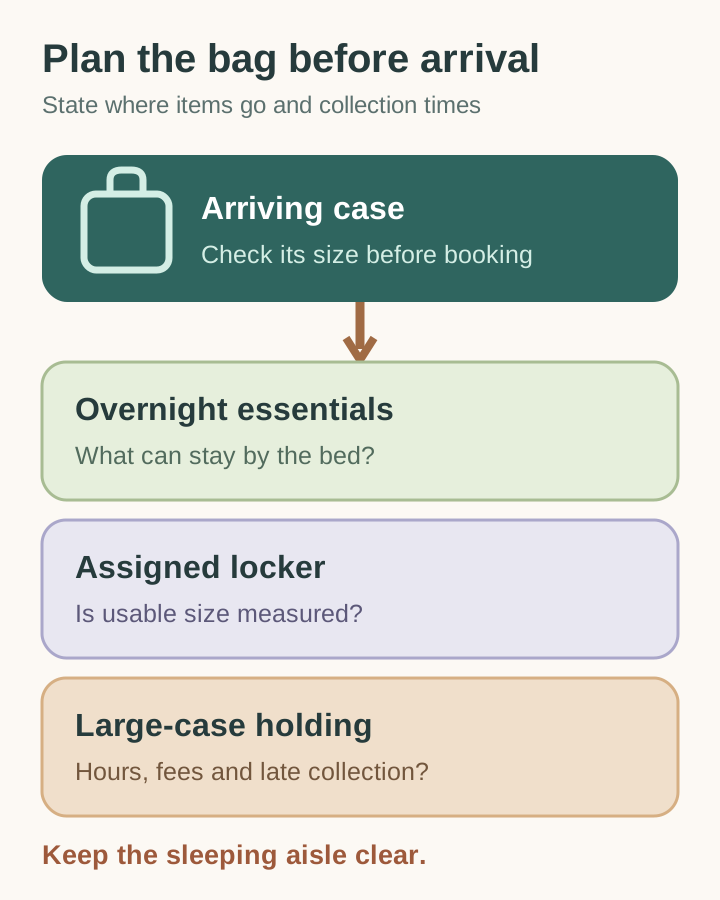
- Publish measured usable locker dimensions only when verified.
- Name locations for small items, large cases and early or late holding.
- State hours, capacity limits and fees beside the booking promise.
- Give guests a preparation plan that keeps the sleeping aisle clear.
6. Test capsule hostel guest comfort before opening
A final walk should follow a stay rather than a technical component list. Ask one person unfamiliar with the project to read the booking page and arrive as a guest. Give them the information and credential that a real traveler would receive. Can they identify the room type, locate their bed and storage, understand the fitted controls, use the bathroom route after dark and find help? Note where they hesitate. The purpose is to find unclear promises and awkward handoffs while there is still time to correct them.
Repeat the walk with an upper and a lower bed if both are sold. Use the site's normal night lighting, closure positions and staff schedule. Include a practical bag, but do not treat one sample case as proof that all luggage fits. Ask the tester to describe what they believe the pod door secures and where valuables belong. If their answer differs from the booking page or staff instruction, fix the information or operation before selling that category. The same principle applies to temperature: ask which control they can change and whom they would contact if uncomfortable.
Record each finding in plain language: location, observation, guest effect, responsible person and next check. A missing sign may have an operations owner; a draft or lock fault needs the relevant technical owner. If a problem affects safe entry, exit or a critical function, keep the affected inventory unavailable until competent staff evaluate it. The operator's guest-readiness decision, installer handover and any local specialist approval remain separate records. This short table is a guest-perspective companion to GEELYE's detailed pre-opening inspection checklist, not a substitute for site testing or regulated review.
After corrections, retest failures and align the booking page, check-in and bedside instructions.
| Moment | Ask the tester | Record or correct |
|---|---|---|
| Before booking | What closes around this bed, and which areas are shared? | Correct category text and room photos. |
| At the bed | Which air or light control can you use? | Confirm installed function and guest instruction. |
| After dark | Can you reach the toilet and return without confusion? | Note signs, lighting, noise and obstacles. |
| Access | What do you do if entry or a locker credential fails? | Check the night assistance process. |
| Luggage | Where does this case go, and can you collect it later? | Verify measured fit, hours and handover rule. |
| Release | Who owns each unresolved issue? | Record owner, recheck and inventory decision. |
Make the whole night understandable
Capsule hostel guest comfort is built from small, connected decisions. A clear privacy description helps guests choose the right bed. Room ventilation and fitted controls need honest instructions. The bathroom route should work under real night lighting. Access and valuables storage need separate explanations, and luggage needs a measured place and a usable time window. Walk that sequence before opening, correct what the tester cannot understand, and keep the guest promise consistent across booking, check-in and overnight support.
The strongest article or room card cannot repair an unresolved site condition. Use the guide to ask better questions of the operator, product supplier and qualified local project team, then publish only the answers the installed property can support.
Related GEELYE resources
Review the capsule setup for your hostel
Send GEELYE the room plan, target guest profile, preferred capsule format and required functions. We can discuss product information and layout questions for your project team to verify on site.
Frequently asked questions
Does a capsule hostel pod give guests a private room?
Usually no. A pod can give a personal sleeping space within a shared room. State the actual closure, shared facilities and room category before the guest books.
Can a guest control the temperature inside a capsule bed?
Only if the installed configuration provides that control. A fitted fan may move air locally, while room temperature depends on the building system. Explain the actual controls and help route.
What should an operator check on the bathroom route at night?
Walk from assigned upper and lower beds to the toilet or wash area and back under normal night lighting. Check signs, steps, door noise, obstacles, bed-number visibility and the help route.
Is a lock on the pod enough for valuables?
Do not treat pod closure and valuables storage as the same service. Explain the installed pod access method, any locker or managed storage, and the process when a credential fails.
How should a capsule hostel state luggage size limits?
Use measured usable storage dimensions and opening clearances for the installed equipment. State where larger bags go, when they can be left or collected, and any capacity limit or fee.